If you’ve ever seen a work van on the road and instantly thought, “That company looks legit,” you already understand the real power of design.
Not the “pretty” kind of design. The kind that works at 35 mph. The kind that can be read in two seconds at a stoplight. The kind that makes someone save your number without even realizing it.
That’s what this blog is about: wrap design and branding education that helps you turn vehicle graphics into real-world results more recognition, more trust, and more calls.
The uncomfortable truth: most vehicle graphics fail for one simple reason
They try to say too much.
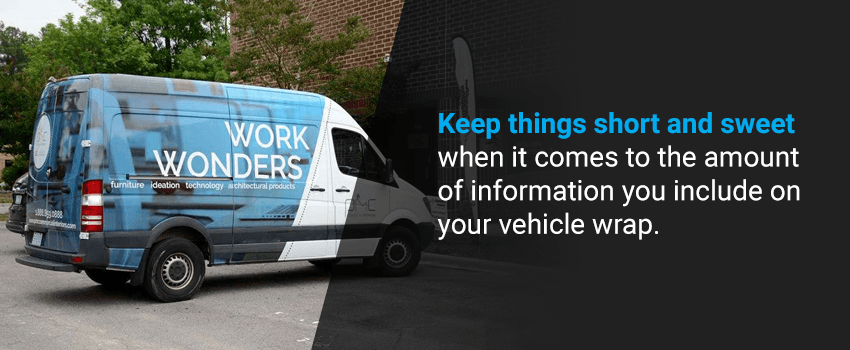
A vehicle is not a brochure. It’s not a website. It’s not a flyer.
Your customer is not sitting down to “review your design.” They’re driving. Walking. Turning their head for a second. They’re busy.
So when a design tries to include every service, every tagline, every social handle, three phone numbers, and a list of certifications… the result is predictable:
They remember nothing.
The best vehicle graphics don’t win by being louder. They win by being clear.
The 3-second rule: how people actually read vehicle wrap design
Here’s what happens in the real world:
- They notice color and shape first
- Their eyes snap to the biggest text or logo
- They try to answer one question: “What do they do?”
- If that’s clear, they look for: “How do I contact them?”
This is why successful vehicle wrap design follows a strict hierarchy:
The winning hierarchy for business vehicle graphics
- Brand name / logo
- What you do (one clear service line)
- Phone number (easy to read)
- Website / location (optional, secondary)
- Trust signal (optional, minimal)
If your design breaks this order, conversion drops no matter how nice it looks on screen.
Principle 1: Design for readability at speed (not for your monitor)
A wrap that looks perfect in a design mockup can fail on the road.
Why? Because monitors don’t simulate:
- distance
- motion blur
- glare
- nighttime lighting
- visual clutter (traffic, buildings, signs)
Quick test: “The 30-foot squint”
Stand 30 feet away from the design (or zoom out until it’s small), squint slightly, and ask:
- Can I read the company name?
- Can I understand the service?
- Can I find the phone number instantly?
If not, simplify.
Readability checklist for vehicle lettering
- Use bold, clean fonts (avoid thin scripts for key info)
- Increase spacing (kerning/leading) for legibility
- Keep service line short (3–6 words is often ideal)
- Prioritize contrast (dark on light, light on dark)
Principle 2: Your phone number is not decoration. It’s the conversion button.
A business wrap is a moving call-to-action. Treat your phone number like the “Buy Now” button on a website.
Best placement for phone numbers (high-conversion zones)
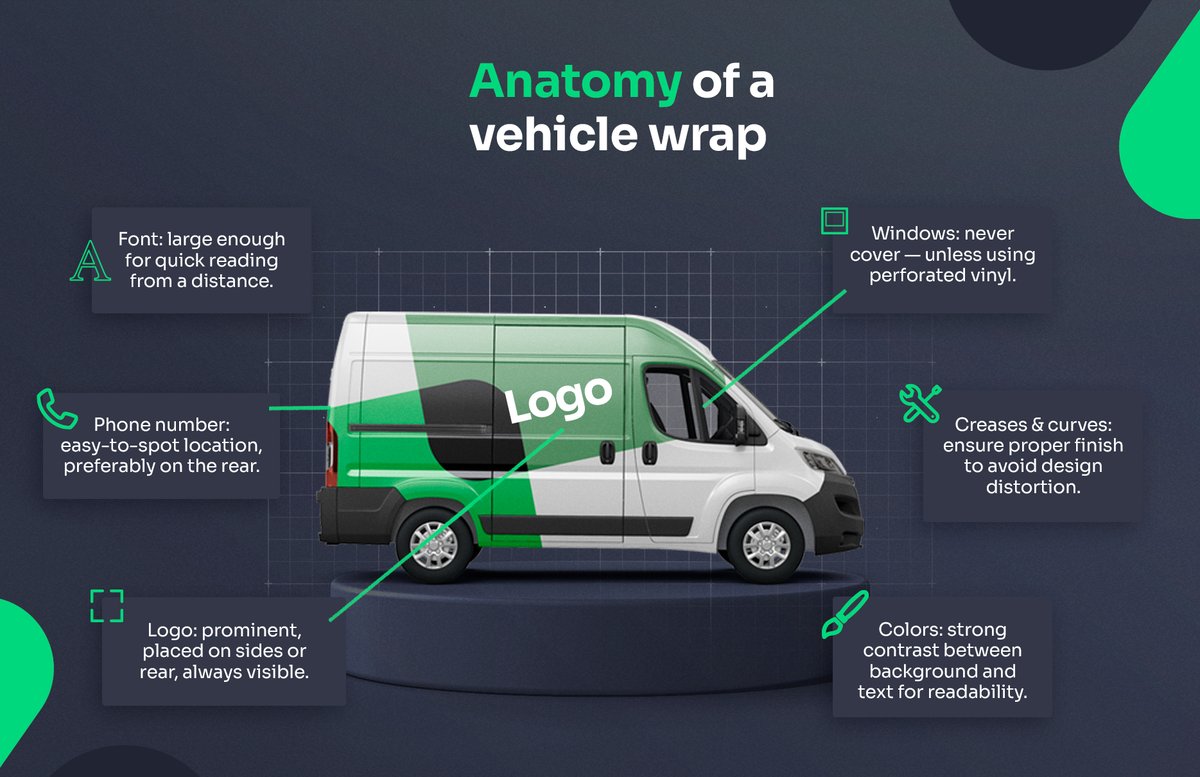
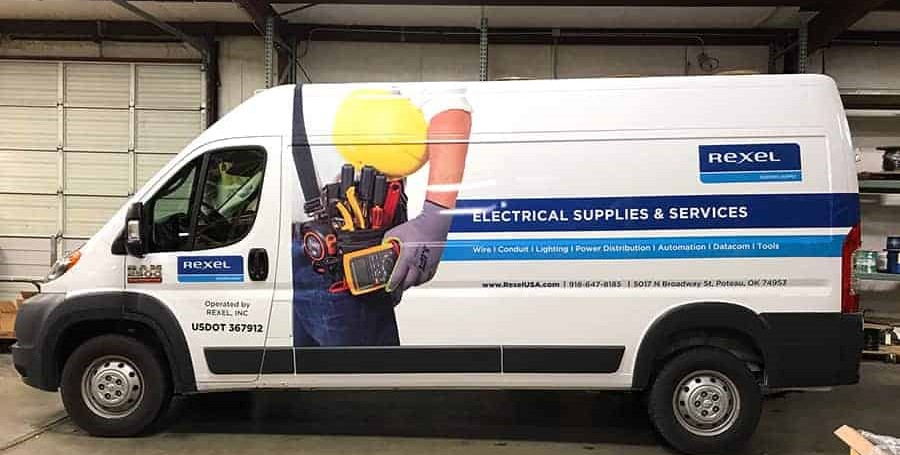
- Rear of vehicle: highest conversion zone (drivers behind you have time to read)
- Large side panel: high visibility while parked or passing
- Avoid low, dirty areas: near wheel wells where road grime reduces readability
Phone number size and style guidelines
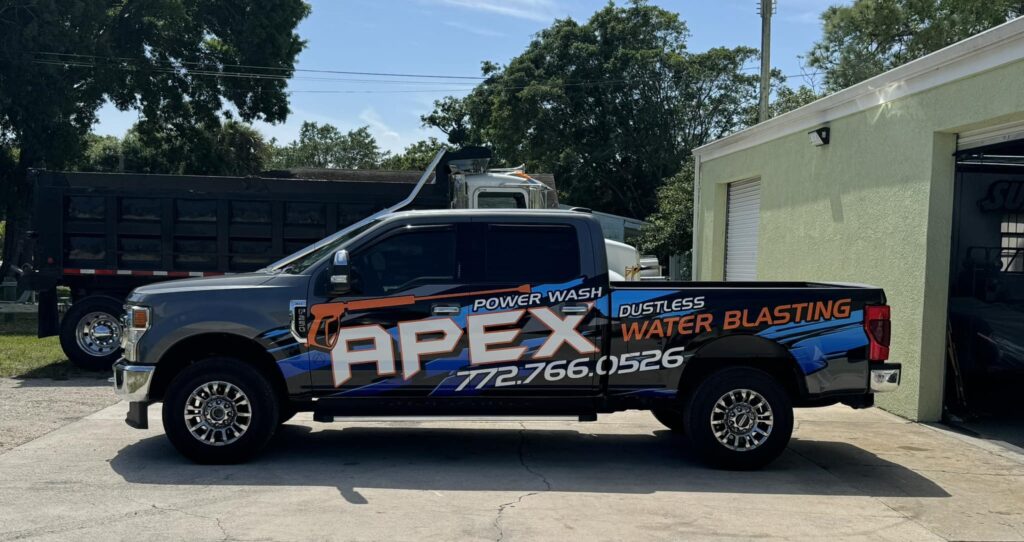
- Make it one of the largest text elements on the vehicle
- Use a bold font with clean shapes (no fancy curves)
- Separate it from clutter (white space is your friend)
- Keep it consistent across the fleet
If you want more calls from vehicle graphics, this is the simplest improvement with the biggest payoff.
Principle 3: Color contrast is your “silent salesperson”
People think color is about style. In vehicle graphics, it’s mostly about function.
The contrast rule
If the background and text are too close in brightness, the text disappears in sunlight and at speed.
High-performing combinations (in real environments):
- white text on deep black/navy
- black text on white/light gray
- bright accent colors only when paired with strong contrast
Don’t “brand yourself into invisibility”
Some brands love light gray-on-white because it feels “premium.” On a vehicle, it often reads as “blank.”
If you want premium and readable:
- use clean layouts
- use fewer elements
- keep contrast strong
Premium is clarity, not softness.
Principle 4: Logo placement that builds trust instantly
Your logo is not just a symbol—it’s the first proof that you’re a real company.
Best logo placement
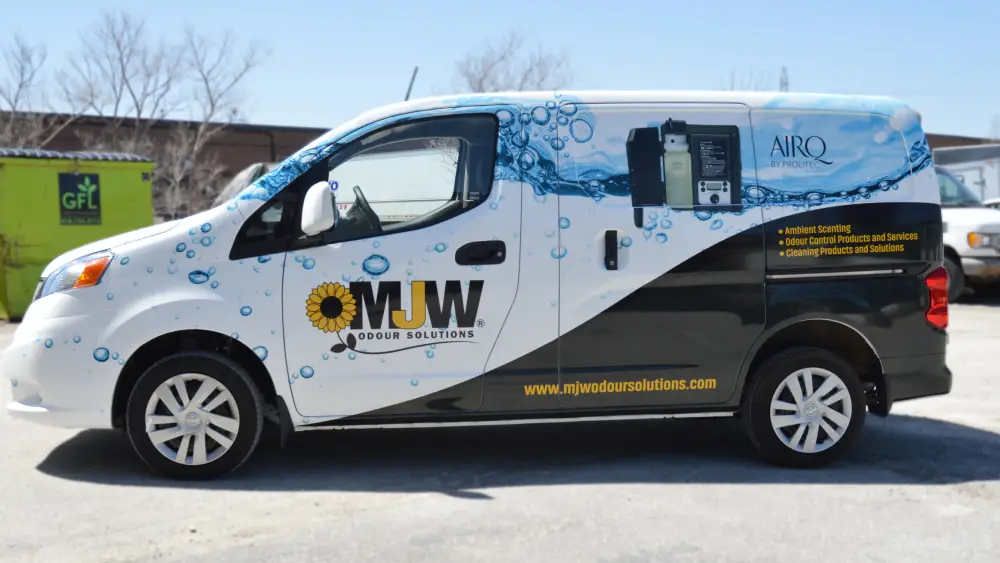
- Front doors: classic, professional, expected
- Mid-side panel: maximum visibility on vans/trucks
- Rear: reinforces brand recall after they read the phone number
Biggest logo mistake
Putting the logo too small and expecting it to “carry the design.”
If your logo is small and your service text is huge, people remember the service but not your name. If your logo is huge but your service is unclear, they remember the brand but not what you do.
Balance matters.
Principle 5: The “one message” approach beats the “everything list”
If you offer 12 services, your wrap should not list 12 services.
Your wrap needs one primary message that people can remember.
Examples of strong one-line service messaging
- “AC Repair & Installation”
- “Plumbing • Drain • Water Heaters”
- “Roofing & Storm Restoration”
- “Towing • Recovery • Roadside”
The goal is not completeness. The goal is clarity.
If someone understands you, they’ll call. Once they call, you can explain everything you do.
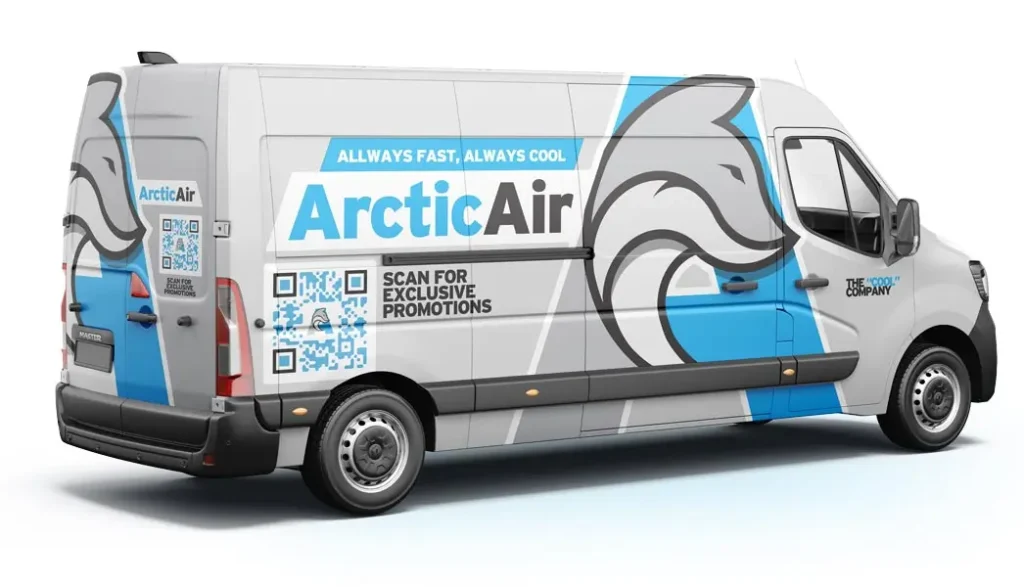
Principle 6: Trust signals work—if you keep them minimal
People buy from companies they trust. A wrap can communicate trust without looking crowded.
High-impact trust signals (choose 1–2)
- “Licensed & Insured”
- “Family Owned”
- “5-Star Rated”
- “Since 2012”
- “Free Estimates”
The key is restraint. Add too many trust badges, and they become noise.
Principle 7: Consistency across vehicles is what makes you look bigger
A single branded vehicle looks professional.
A consistent fleet looks established.
If you have multiple vehicles, consistency becomes a sales tool:
- customers recognize you faster
- your brand feels “everywhere”
- your team looks organized on job sites
Fleet consistency essentials
- same logo placement rules across vehicles
- same core colors and font system
- same service line format
- same phone number position and size hierarchy
This is branding that customers can feel even if they can’t explain it.
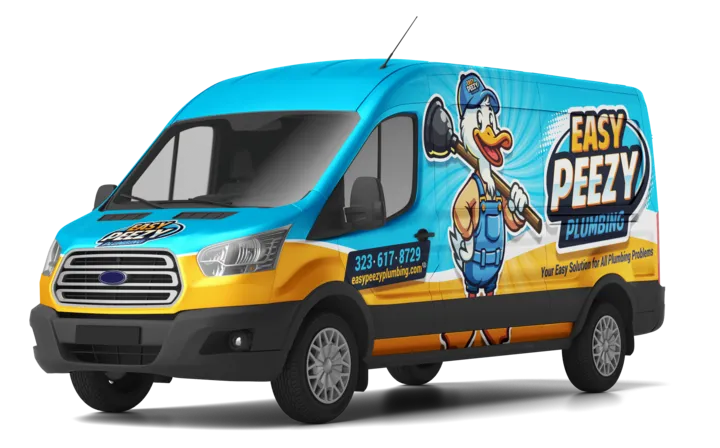
The simple layout formula that converts (steal this)
Use this structure for most service businesses:
Side panel layout
- Large logo or brand name
- One clear service line
- Big phone number
- Optional: website or area served (small)
Rear layout
- Big phone number first
- Website second
- Small logo for reinforcement
- Optional: short CTA (“Call Today” / “Free Estimates”)
This layout works because it follows how people scan vehicles naturally.
A quick story: why “clean design” often outperforms “creative design”
A business owner once asked for a wrap with:
- 10 services
- 2 taglines
- 3 icons per service
- a background pattern
- social handles
- QR code
- and a gradient overlay
It looked impressive on the mockup.
But in real life? At speed? It was a blur.
When we simplified to:
- brand
- one service line
- one CTA
- one phone number
The vehicle finally worked like advertising because people could read it.
Great vehicle wrap design isn’t about showing everything. It’s about making the right thing impossible to miss.
Wrap Design Checklist (before you approve your final proof)
Use this before you print anything:
- Can someone read your company name in 2 seconds?
- Can they understand what you do without effort?
- Is your phone number one of the biggest elements?
- Is the contrast strong in bright sunlight?
- Does the design still work when you zoom out small?
- Is the layout consistent with your other vehicles or signage?
- Is the message short enough to remember?
If you answer “no” to any of these, revise before printing.
FAQ: Design & Branding for Vehicle Wraps and Decals
What’s the best font for vehicle lettering?
Bold, clean, highly legible fonts perform best. Thin scripts and decorative fonts usually fail at speed.
Should I add a QR code to my vehicle graphics?
Only if it’s large enough and placed where people can realistically scan (parked locations). Most “on-road” QR codes don’t convert well compared to a clear phone number.
How much text is too much on a wrap?
If it can’t be read in 2–3 seconds, it’s too much. Prioritize one message and one action.
What’s more important: logo or phone number?
For conversion, phone number placement and readability are critical. For recall, logo matters. The best designs make both clear, but the phone number usually deserves bigger priority on the rear.
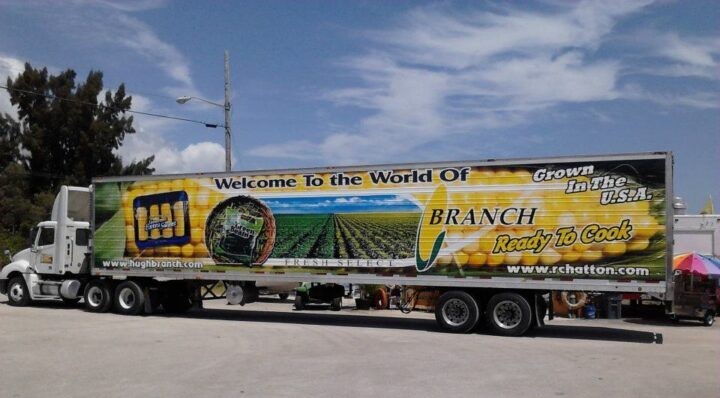
Want a Wrap/Decal Design That Actually Gets Calls?
If your goal is more leads not just a nice-looking vehicle start with the essentials:
- your vehicle type (year/make/model or photo)
- your logo (any format you have)
- your core service line (one sentence)
- your phone number and website
And we’ll help you build a layout that’s:
- readable at speed
- clean and professional
- consistent with your brand
- optimized for calls and quotes